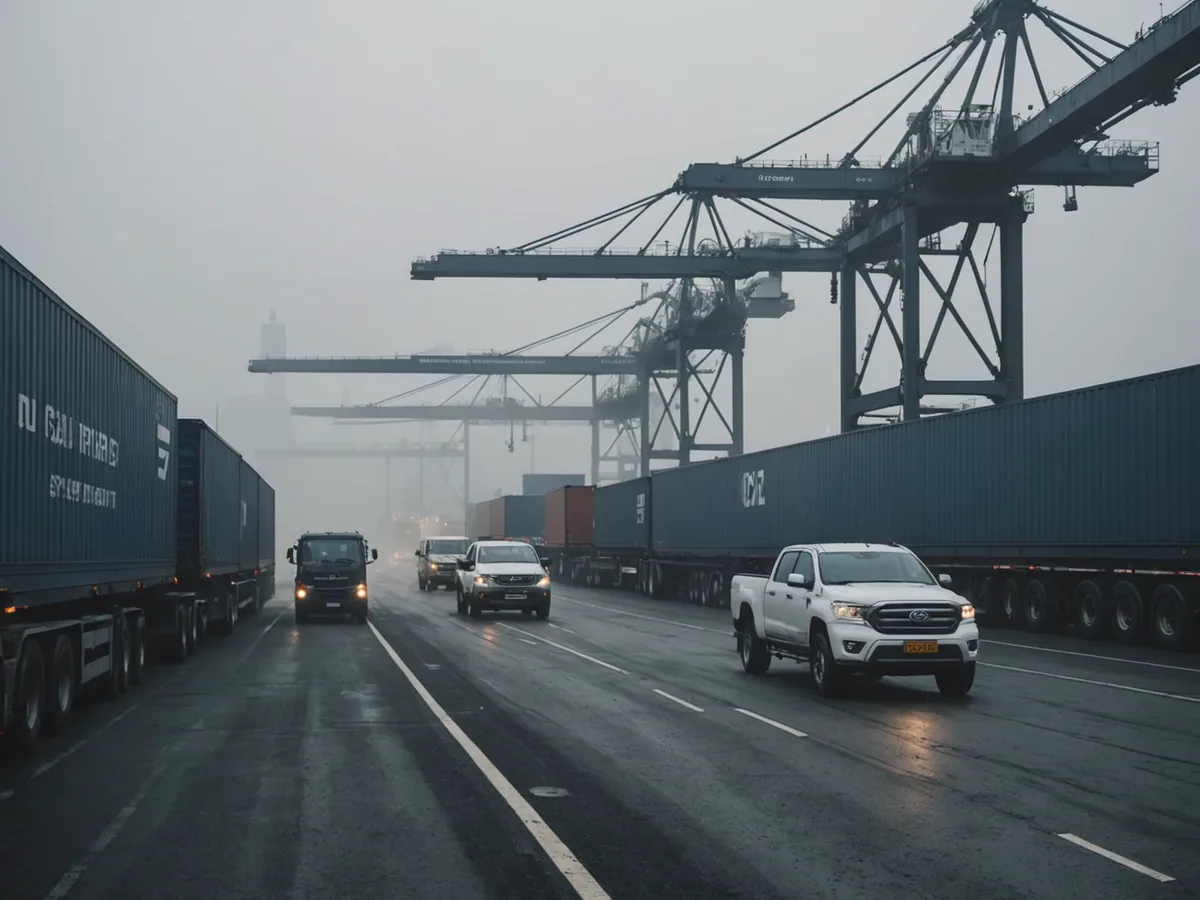
Port congestion events do not arrive with announcements. They develop over hours as vessel arrivals bunch, yard density increases, and terminal operations slow under the weight of unplanned volume. By the time the effects appear in your visibility data -- vessel delay confirmed, slot pushed, ETA revised -- the congestion that caused it has been building for six to twelve hours. Your free time window may already be half consumed.
The desks that navigate congestion episodes with minimal detention damage do not react better than other desks. They pre-position better. There is a meaningful difference between those two things.
How congestion propagates to your freight desk
Understanding the propagation chain matters because it tells you where the early signal sits and how much lead time you actually have.
A congestion event at a major hub port typically follows this sequence: vessel arrival bunching (two or three vessels arrive within a narrow window because of weather delays earlier in the voyage) creates yard density pressure. Terminal cranes slow as crane operators prioritize moves by vessel departure urgency. Dwell times for containers already in the yard increase. Gate appointment windows become harder to book because yard density limits gate access. Vessels waiting for berths experience final ETA revisions, which cascade into changed arrival sequences and pushed slot windows for inbound loads.
The early signal in this chain is the vessel arrival bunching, which is visible in AIS data before it becomes visible in terminal system events. Desks with direct AIS monitoring or access to an aggregated vessel scheduling feed can see this signal two to four hours before the terminal's slot rescheduling notices hit their TMS.
Two to four hours is enough time to start the rerouting process. That window disappears entirely if the desk is waiting for a TMS disruption alert that fires after the terminal has already acted.
Phase 1: Pre-event preparation
Before any specific congestion event, the desk should maintain a standing congestion response checklist per major hub port on their active lanes. For European freight operations, this typically means at minimum: Rotterdam, Antwerp, Hamburg/Bremerhaven, and Felixstowe.
The checklist does not need to be complex. It needs to answer four questions quickly when the situation is developing:
- Which active loads are transiting or arriving at this port in the next 48 hours?
- What is the free time window for each of those loads?
- Which carriers have capacity on alternative routes from/to this hub right now?
- What is the total detention cost exposure if we do nothing for 24 hours?
Answering these questions in real time during a developing congestion event is too slow. Building the data structure that lets you answer them in under two minutes is the pre-event work. Most desks do not do it. The ones that do consistently spend less time in reactive mode.
Phase 2: The first 30 minutes after signal detection
Once the desk identifies that congestion is developing, the first 30 minutes determine how much of the damage is preventable. The sequence that works:
Minutes 1 to 5: Pull all active loads with a port-of-call or transhipment at the affected terminal in the next 72 hours. Sort by free time expiry -- tightest window first. This is your exposure list.
Minutes 6 to 15: For the top 30 to 40 percent by exposure, run carrier availability checks. Which carriers have confirmed capacity on alternative lanes that bypass or substitute the affected hub? At this stage you are not confirming reroutes -- you are identifying which loads have viable alternatives and which are likely to be forced to absorb the delay.
Minutes 15 to 30: For loads with viable alternatives and tight free time windows, initiate carrier hold or provisional booking. Not a confirmed reroute -- a hold that keeps capacity available while the desk notifies shippers and waits for the congestion picture to clarify.
The purpose of the provisional hold is to buy time at a lower cost than paying for urgency later. Carriers charge spot premiums when they know you are in trouble. A desk that reaches them during the first 30 minutes of a developing event typically pays close to its negotiated rates. A desk that calls at hour three is in the spot market.
Phase 3: The decision window
Two to four hours after initial signal, the congestion picture is usually clearer. Terminal notices have propagated. Vessel revisions are confirmed. The desk now has to make actual rerouting decisions.
The decision framework at this point involves three categories of loads:
| Category | Profile | Action |
|---|---|---|
| Reroute now | Free time under 12 hours, alternative carrier confirmed | Execute provisional hold, confirm with shipper, write back to TMS |
| Hold and monitor | Free time 12-36 hours, port timeline uncertain | Keep provisional hold active, re-evaluate at 6-hour intervals |
| Accept delay | Free time over 36 hours or no viable alternative | Document timeline, notify shipper of revised ETA, monitor for worsening |
The "hold and monitor" category is where most desks lose money through indecision. Loads that sit in this category for six hours without a decision typically end up in "reroute now" territory but with the provisional hold expired and the carrier no longer available at the held rate. The discipline is to reassess at the stated interval rather than deferring until the situation forces the hand.
The documentation that matters post-event
After a congestion event resolves, two things are worth capturing in the desk log that rarely happen: the total time from first signal to rerouting decision on each affected load, and the detention fees paid versus the fees that were prevented.
This data is not for the invoice. It is for the post-event review that tells you whether your pre-positioning actually worked. A desk that handled twelve loads during a congestion event, rerouted eight of them before detention accrued, and paid fees on four -- and knows that breakdown -- is a desk that can improve specifically. A desk that only knows "we had a bad week at Rotterdam" cannot.
What a playbook does not fix
A congestion playbook addresses process. It does not address the structural constraint that on a genuinely severe multi-day congestion event -- the kind that backs up vessels across the North Sea for 72 or more hours -- some detention is simply unavoidable because alternative routing capacity is itself constrained. There are periods when every desk in the market is looking for the same alternative lane, and the market price for that capacity reflects the scarcity.
Pre-positioning and fast response compresses your detention exposure. It does not reduce it to zero. Desks with the best processes will still pay some detention during a major congestion episode. The goal is paying for genuinely unavoidable events, not for slow internal response on loads that had viable alternatives.